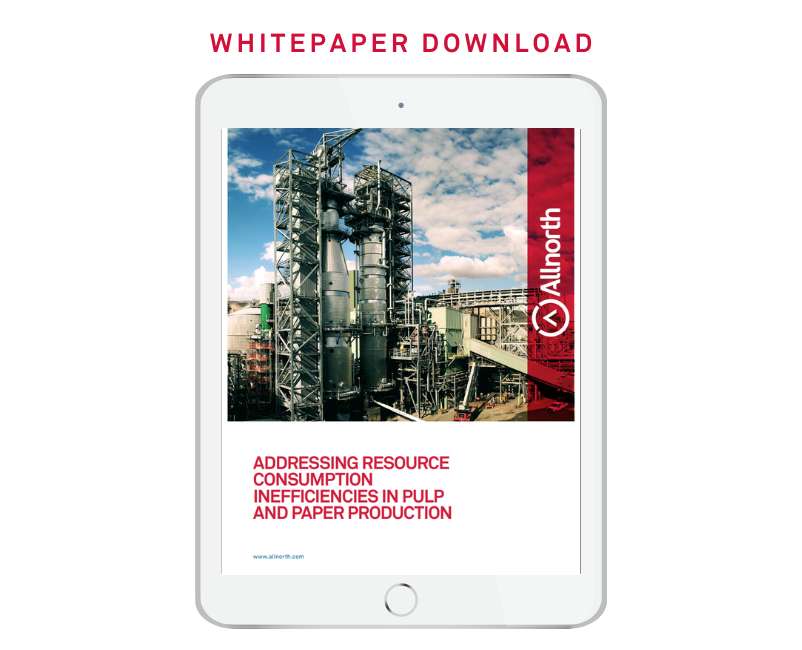
Addressing Resource Consumption Inefficiencies in Pulp & Paper Production

Eliminate Inefficiencies Long Term
The processes used to convert wood fibers into pulp and paper products require a substantial amount of energy and water. But these resources are not free and there is not an infinite supply available. Therefore, mill production costs are rising, and frequently in a nonlinear fashion as many mills experience challenges with production capacities being pushed well beyond what the mill was designed for. As a result, these necessary energy- and water-intensive processes are under constant scrutiny for optimization in most mills.
- The three most common culprits of resource inefficiencies in mills, and how to address each one
- How and why you should eliminate assumptions about your processes
- Why taking a holistic approach will make your mill more efficient
- Best practices for measuring and tracking mill improvements
- Allnorth’s proven approach to eliminating long-term inefficiencies
Access the Whitepaper
Presenters

Douglas McKenzie, P.Eng., CEM
Douglas McKenzie is a Principal Process Engineer with over 30 years of chemical/process engineering experience. Douglas is responsible for leading/assisting corporate process engineering initiatives and has contributed his expertise to help clients reduce process related expenses, optimize power usage, and increase their capacity to generate power. Douglas is a lecturer and a published author. He has been awarded two patents and has received a BC Hydro Power Smart Energy Champion award for his leadership in energy reduction. He is a Certified Energy Manager (CEM) and is licensed to practice in both British Columbia and Alberta.